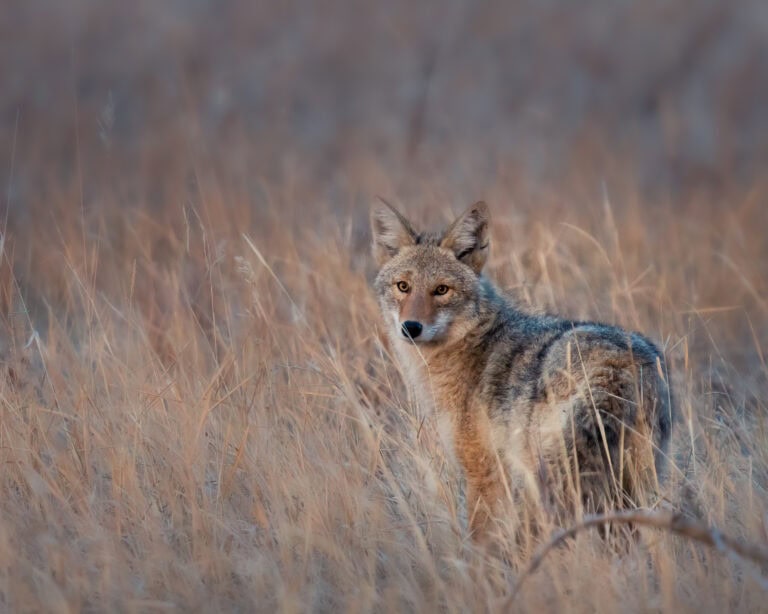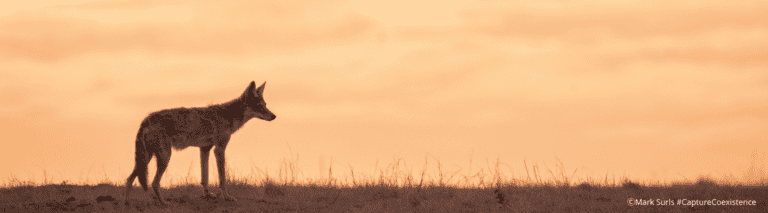


Across North America, coyotes have adapted in remarkable ways to survive alongside us. From rural ranchlands to suburban neighborhoods and major cities, these intelligent, resilient carnivores continue to find ways to survive in human-dominated landscapes. As they do, more people are encountering them–often with a mix of awe, concern, and fear.
Project Coyote’s Coyote Friendly Communities (CFC) program was created to help neighborhoods adopt science-based, humane strategies that allow people and wildlife to coexist safely. Through this program, we equip local leaders, community members, and decision-makers with practical tools to prevent conflicts before they occur.
At its core, this work helps turn the tide on the relentless persecution that coyotes have historically faced, and too often still face because of outdated wildlife management policies and misunderstanding. Hundreds of thousands of coyotes are still killed each year through trapping, shooting, poisoning, and other lethal methods—many of which cause unnecessary, prolonged animal suffering and separate coyote family members from one another.
These killings are often justified as necessary for the safety of people or domestic animals or a general goal of population control. But decades of research tell a very different story. Indiscriminate killing rarely solves conflicts with coyotes and, by destabilizing their social structure, can actually lead to increased reproduction and movement of new animals into an area. In other words, lethal control is not only cruel—it’s ineffective and counterproductive.
Why Coyotes Matter
Coyotes play an essential role in healthy ecosystems. As mid-level predators, they help regulate rodent populations and overabundant prey animals that can damage crops, spread disease, and damage bird, reptile, and amphibian populations.
But beyond their ecological role, coyotes are also highly social, intelligent animals with complex family structures. They mate for life, raise pups cooperatively, and teach their young how to navigate the landscape, including how to avoid humans.
Coyotes naturally prefer to keep their distance from people. Conflicts usually arise when human behaviors, such as unsecured garbage, outdoor pet food, fallen fruit, or deliberate feeding, unintentionally attract wildlife.
When communities understand these dynamics, coexistence becomes not only possible, but straightforward—and replaces outdated lethal methods that cause so much suffering.

What Coyote Friendly Communities Do
Communities participating in CFC efforts typically focus on several key steps:
- Public education about coyote behavior and ecology (read our profile on Coyotes here)
- Reducing wildlife attractants such as unsecured trash, pet food, and compost (reference our Yard Audit Checklist)
- Encouraging responsible pet supervision (read more in our Dogs and Coyotes fact sheet)
- Posting educational signage in parks and neighborhoods (see our Be Coyote Aware and Don’t Feed Wildlife educational signs)
- Teaching humane hazing techniques that reinforce coyotes’ natural wariness of people (learn more in our Hazing Field Guide)
- Adopting science-based coexistence policies rather than defaulting to lethal control (reference this graphic describing Why Killing Coyotes Doesn’t Work)
These strategies have been implemented successfully in cities and towns across the United States. When residents understand what attracts coyotes and how to respond appropriately during encounters, fear decreases, and both perceived and real conflicts become far less common.
A Community Comes Together in Baldwin Hills
Recently, the power of community education became clear in Baldwin Hills, Los Angeles.
Last year, coyote presence in the neighborhood led residents to begin considering hiring wildlife trappers to remove the animals—an approach that would likely mean death for at least some pack members. Concerned community members reached out to Project Coyote for support before the situation escalated.
After discussions with Los Angeles Animal Services and the Department of Agriculture, concerned residents understood that lethal removal wouldn’t solve the community’s concerns. In turn, neighbors decided to explore other options.
With support from Project Coyote staff, local residents organized a presentation on coyote coexistence through the community’s homeowners’ association. Over 30 neighbors attended the meeting, where they learned about normal coyote behavior, why sightings are often misinterpreted as threatening, and what steps residents can take to reduce conflicts that may arise.
The conversation led to a palpable shift in community confidence and understanding. Participants engaged by asking thoughtful questions about keeping pets safe, reducing wildlife attractants in their yards, and how to respond if they encounter a coyote during a walk. By the end of the meeting, many residents said they felt far less afraid and more aware of the science behind coexistence.
One Baldwin Hills community advocate shared how important our support was in helping the neighborhood shift course:
“Project Coyote resources were critical in helping my neighborhood decide to pursue a coexistence strategy with coyotes, pivoting from an initial proposal that included lethal control. The science-based information, infographics, and model plan available on their website were incredibly helpful, as was the personal guidance we received from Project Coyote staff, who worked with us on a customized plan for our community that we have started to implement.”
The community took concrete steps to make Baldwin Hills coyote friendly, including posting educational signage around the neighborhood and disseminating coyote coexistence brochures at community events. Residents created a community website to share information and resources on living safely with coyotes.
Most importantly, early plans to bring in trappers were abandoned.
What began as a potential lethal response became a model of community collaboration and coexistence.

How You Can Help Make Your Community Coyote Friendly
Every community can take steps toward coexistence.
If coyotes live in your neighborhood—or if you simply want to help protect them—the first step is education. Learning about coyote behavior and sharing accurate information can prevent fear-based reactions that often lead to unnecessary killing.
Project Coyote provides a wide range of free resources for community advocates, including:
- A Model Coyote Coexistence Plan for municipalities and communities
- A Guide for Community Advocates to help organize local education efforts
- Signage, brochures, and outreach materials on our Downloadable Resources page
- Training resources on how to talk with communities about coexistence
Small actions can make a big difference. Hosting a community presentation, posting educational signs around your community, or simply sharing information with neighbors can shift the conversation from fear and anger to understanding, confidence, and a commitment to coexistence.
Coyotes have lived on this continent for hundreds of thousands of years. As human development continues to expand into wildlife habitat, learning to coexist with them is not only the compassionate choice—it’s the practical one.
Through Coyote Friendly Communities, both people and wildlife can thrive together for generations to come.